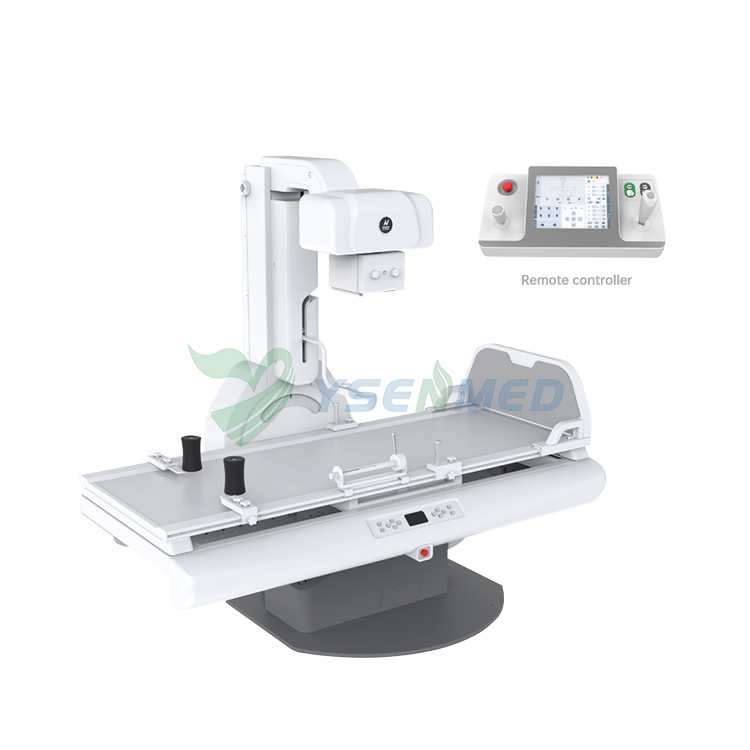
Hospital administrators, radiology directors, and procurement specialists frequently investigate x ray machine cost when budgeting for new installations, system replacements, or departmental expansions. Understanding factors that affect the cost of an X Ray machine enables more accurate financial planning and helps facilities align equipment choices with clinical priorities and long-term operational goals. This detailed industry article examines the primary elements that shape X Ray machine pricing factors, cost of X Ray machines, and hospital X Ray machine pricing, providing practical insights for decision-makers evaluating medical X Ray equipment cost and digital X Ray machine price comparison. Moreover, suppliers like Ysenmed deliver balanced hospital imaging equipment pricing solutions that combine dependable performance with thoughtful design considerations tailored to real-world radiology needs.
Core Technology Components Driving Cost Variations
The imaging chain forms the foundation of every X-ray system, and choices within this chain create the largest differences in overall investment requirements.
Detector Technology and Size
Flat-panel detectors represent the single biggest contributor to system differentiation. Cesium iodide scintillators generally provide higher detective quantum efficiency than gadolinium oxysulfide, resulting in superior low-dose performance and clearer visualization of fine structures.
Moreover, larger detector formats (43×43 cm or 35×43 cm) support full-field chest and abdominal imaging without stitching, while smaller cassettes (24×30 cm) offer greater positioning flexibility. Wireless detectors eliminate cable management issues but incorporate batteries, antennas, and ruggedized enclosures that add engineering complexity. Therefore, the choice between fixed large-format panels, wireless cassettes, and retrofit-compatible detectors significantly influences factors affecting X Ray machine prices.
Generator Power and High-Voltage Design
Generator capacity determines penetration through dense anatomy and the ability to maintain consistent exposure parameters across patient sizes. Higher kilowatt ratings deliver greater flexibility but require more substantial electrical infrastructure.
Additionally, high-frequency inverters minimize voltage ripple and improve output stability compared with older single-phase or three-phase designs. However, advanced generators often include automatic exposure control algorithms tailored to specific anatomical regions. Consequently, generator specifications play a major role in what affects the cost of hospital X Ray machines.
Image Processing and Software Capabilities
Contemporary systems rely heavily on post-acquisition processing to enhance diagnostic utility. Noise-reduction algorithms, edge enhancement, scatter correction, virtual grid suppression, and anatomical-specific contrast optimization all contribute to final image appearance.
Furthermore, built-in dose-index tracking, reference air kerma displays, and structured dose reporting support compliance with modern radiation protection guidelines. However, advanced features such as automated stitching for long-bone or full-spine studies, dual-energy subtraction, and AI-assisted abnormality flagging increase software development investment. Therefore, processing sophistication directly affects how features impact the cost of X Ray machines.
System Configuration and Mobility Options
The physical design and intended use case create substantial differences in complexity and supporting infrastructure.
Fixed Floor-Mounted and Ceiling-Suspended Systems
High-volume departments typically install floor-mounted or ceiling-suspended units for general radiography. Ceiling designs maximize room utilization and allow tube movement without floor tracks, while floor-mounted systems offer simpler installation in many retrofit situations.
Moreover, motorized columns, automated tube-detector tracking, collision-avoidance sensors, and weight-bearing tables add mechanical sophistication. However, these features improve technologist efficiency and patient safety. Therefore, configuration choices significantly contribute to cost breakdown of different types of X Ray machines.
Mobile and Portable Radiography Units
Emergency departments, ICUs, operating theaters, and isolation areas require mobile or portable solutions. Motorized mobile units with battery-powered drives navigate corridors easily, while lightweight portable systems fit into tight spaces or field environments.
Additionally, quick boot times, touch-screen interfaces, and integrated dose reporting support rapid examinations under time pressure. However, battery management, ruggedized construction, and wireless detector integration add engineering requirements. Consequently, mobility level heavily influences relative diagnostic imaging machine costs.
Specialized Configurations (C-Arm, Mammography)
C-arm fluoroscopy systems incorporate rotating gantries, pulsed acquisition modes, and often 3D reconstruction capabilities for interventional and intraoperative guidance. Mammography units feature precise compression mechanisms, tomosynthesis hardware, and automated exposure control tailored to breast tissue.
However, these specialized designs require unique mechanical and software engineering. Therefore, application focus creates distinct cost profiles within the broader X Ray machine pricing factors landscape.
Infrastructure and Site-Preparation Requirements
Site readiness frequently adds substantial expense beyond the equipment itself. Radiation shielding assessments determine lead thickness for walls, doors, and windows. Electrical upgrades ensure stable three-phase power delivery to high-kW generators.
Additionally, structural reinforcements support ceiling-mounted tube weights, while HVAC modifications maintain temperature and humidity within detector specifications. IT infrastructure planning includes network drops, DICOM routing, cybersecurity hardening, and workstation placement. Therefore, infrastructure readiness represents a major component in cost breakdown of different types of X Ray machines.
Service, Maintenance, and Lifecycle Considerations
After-sales support significantly affects long-term economics. Comprehensive service agreements typically cover preventive maintenance, priority response, software updates, and parts replacement.
Moreover, manufacturers that provide remote diagnostics, predictive-maintenance alerts, and extended parts availability help avoid costly emergency repairs. Training programs that cover both initial operator familiarization and advanced protocol optimization reduce user errors and maximize system utilization.
Furthermore, modular upgrade paths allow departments to add capabilities (e.g., AI modules, higher-capacity detectors) without full system replacement. Therefore, evaluating X Ray machine pricing factors requires careful assessment of warranty terms, service-level commitments, and post-warranty support structures.
Comparison Table: Relative Cost Drivers by Equipment Category
The table below illustrates key cost-influencing factors across common hospital X-ray categories.
| Equipment Category |
Primary Clinical Application |
Major Cost Drivers |
Infrastructure Intensity |
Typical Upgrade Path |
Service Intensity |
| Floor-Mounted Fixed DR |
General high-volume radiography |
Large detectors, motorized mechanics |
High |
Detector swaps, software enhancements |
Moderate |
| Ceiling-Suspended Fixed |
Orthopedic & spine imaging |
Ceiling rails, collision sensors |
Very High |
Generator upgrades, advanced processing |
Moderate |
| Wireless Flat-Panel Detectors |
Multi-room flexibility |
Battery, wireless electronics |
Low to Moderate |
Firmware updates, new panel additions |
Low |
| Mobile Radiography Units |
Ward & ICU bedside |
Motorized drive, battery capacity |
Low |
Battery replacements, software upgrades |
Low to Moderate |
| Portable Radiography Units |
Emergency, isolation rooms |
Lightweight chassis, compact battery |
Minimal |
Minimal upgrades, mostly maintenance |
Low |
| Surgical C-Arm |
Intraoperative guidance |
Rotating gantry, flat-panel detector |
Specialized |
Software packages, 3D module additions |
High |
| Digital Mammography |
Breast screening & diagnostics |
Compression system, tomosynthesis hardware |
Dedicated |
Detector upgrades, software enhancements |
Moderate |
This overview clarifies how different categories contribute to factors affecting the cost of X Ray machines in hospitals.
Strategic Approaches to Cost-Effective Procurement
Experienced procurement teams employ several proven strategies to optimize hospital equipment budget for X-ray systems.
- Conduct thorough current-state and future-state volume mapping to avoid over- or under-specification.
- Prioritize mature technology with strong field reliability over unproven advanced features that may increase service complexity.
- Bundle initial training, first-year service, and common spares into the acquisition package to lock in predictable early-year expenses.
- Explore modular upgrade paths that allow phased enhancements rather than full replacement.
- Request multi-year service agreements with defined pricing escalation caps to improve long-term budget predictability.
- Standardize on a single manufacturer across multiple sites to leverage parts commonality and consolidated training.
Ysenmed helps hospitals implement these strategies by offering flexible configurations, modular designs, and transparent lifecycle planning that align with both immediate needs and future growth objectives.
Implementation and Post-Installation Optimization
Successful deployments begin with collaborative site planning involving radiology, biomedical engineering, IT, and facilities teams.
Moreover, comprehensive initial and ongoing training ensures technologists master dose-optimized protocols and workflow efficiencies. However, phased go-live strategies minimize disruption in high-volume departments. Therefore, departments maintain throughput while integrating new capabilities.
Furthermore, establish joint performance reviews with the manufacturer at regular intervals. Regular detector calibration, grid alignment checks, and dose audits keep systems performing optimally.
Consequently, well-managed implementations deliver sustained improvements in image quality, examination speed, and radiologist satisfaction.
In conclusion, understanding how much does an X Ray machine cost for hospitals requires a comprehensive view of technology choices, infrastructure needs, service commitments, and lifecycle support. By focusing on factors affecting the cost of X Ray machines in hospitals and partnering with manufacturers like Ysenmed that emphasize practical value and long-term reliability, radiology departments secure imaging solutions that support excellent patient care while aligning with responsible financial planning.
FAQ
How much does an X Ray machine cost for hospitals varies significantly by technology type, configuration, and infrastructure requirements.
What is the average cost of X Ray machines for hospitals and clinics?
Average cost of X Ray machines for hospitals and clinics depends on fixed versus mobile design, detector type, and integration complexity.
What does a cost breakdown of hospital X Ray machines include?
Cost breakdown of hospital X Ray machines encompasses equipment, site preparation, installation, training, and ongoing service commitments.
What factors affecting the cost of X Ray machines in hospitals are most significant?
Factors affecting the cost of X Ray machines in hospitals include detector technology, generator power, mobility features, and lifecycle support.
How does cost comparison of X Ray machine models for hospitals help decision-making?
Cost comparison of X Ray machine models for hospitals reveals trade-offs between initial capability, infrastructure demands, and long-term operational efficiency.